When people learn that my career is about tackling climate change and advancing ecological sustainability, I am sometimes asked, with an agonising, sheepish look, “But there is hope, right?”
The question of hope is asked as if, were I to say “No,” then I would be failing in some moral way; not someone else. The question feels loaded, as if I am responsible for their sense of hope, and if I don’t give it to them, then I am being heartless.
Whether we succeed or not in preventing the climate and nature crisis from deepening and causing even greater catastrophes, is that my personal moral failure? Reasonable people could differ on whether I’ve led a moral life, but I think I do okay in that respect.
By contrast, I agree that the deepening crisis is symbolic of my profession’s failure.
To-date, everyone who works on sustainability has, to put it bluntly, failed, since the climate and nature crisis has worsened. Brilliant people have helped make important gains, they’ve designed and delivered great projects, and they continue to do so, and all of that has definitely slowed the deteriorating situation. Nevertheless, the combined impact of all this great work has not been anywhere near enough to prevent the disasters that are now unfolding.
In our defence, sustainability professionals bare only the tiniest responsibility.
Our main failure has been that we did not develop and—crucially—socialise a series of pragmatic policy proposals to tackle the root cause of non-sustainability: the rapacious, extractive economic system that is embedded completely into our collective psychology and political cultures, and which makes it virtually impossible to live sustainably.
Doughnut Economicsis a brilliant attempt at a practical policy tool, but despite its brilliance, its adoption has been unfortunately limited. All power to the Doughnut Economics Action Lab in growing their influence and impact.
Since that rapacious extractive economic system still flourishes, that brings me back to the question, Is there hope?
Even without the moral overtones, the question of hope is complicated. It’s presented as a yes or no question, but the climate and nature crisis is nowhere near that simple.
There are reasons for profound anxiety. Many of the best sustainability professionals I know lose sleep, literally, because of the stress caused by having intimate knowledge of all the problems and, therefore, being a voyeur on the end of the world as we know it. Terrible things are now locked in and unpreventable.
An important part of why this is so stressful is that, as well as understanding the problems, sustainability professionals also know that the climate and nature crisis was entirely preventable; that we could stop the harmful things humanity is doing; that we could turn the ship around; but also that the extractive economic system is too big and too powerful, and it is bolstered by people, values and cultures that do not understand, or refuse to understand, or don’t care about the calamities being created by the system they support.
The public is increasingly aware that the economic system is failing them, but more and more are going down the rabbit hole presented by populists, instead of looking for genuinely effective solutions. The populists are a useful vent for anger—and people should be angry with the cheerleaders for flailing and destructive economics—but nothing else. Certainly, when it comes to scientific literacy, populists are, at best, ignorant and, at worst, environmental despots, making our futures less safe and less prosperous. Populists have no answers for the climate and nature crisis that aren’t moronic.
And so, with growing support for populists who want to dump the Paris Agreement and Net Zero goals (which are, in any case, only a piss-weak target; far short of what’s needed for public safety), we sustainability professionals see our communities sliding further away from solving the climate and nature crisis.
The frustration is that the economic, technological, policy and behavioural solutions already exist.
Read that again.
The economic, technological, policy and behavioural solutions already exist.
So, what are we waiting for? Why aren’t they being rolled-out and the necessary speed and scale to stop and reverse the crisis?
The Social Licence Crisis
The fundamental problem is that there is still—a staggering 130 years after the first peer-reviewed scientific paper on anthropogenic global warming—the social licence crisis.
The social licence crisis is this situation now, where we have a continuing and generous social licence for environmental bads, like fossil fuels, and insufficient social licence and, indeed, demand for truly ambitious and effective environmental and economic reforms.
Hope will only exist if we are tackling the social licence crisis; if we can invert that ratio; if we can deprive environmental bads of public acceptance, and if we can create a public insistence for ambitious, rapid environmental and economic reforms.
If someone’s approach to sustainability is just ‘hope’ and leaving it to others, then that someone is accepting (perhaps unknowingly) that there just isn’t enough of us to create the necessary momentum for reform.
If, on the other hand, you’re prepared to act, if you are part of inverting the social licence ratio and helping build massive public pressure for reform, then there is hope that things will be less bad. But you have to decide to take action, at home, at work, and in your community. And it has to be one of, if not the highest priority with your local member(s) of parliament, and when you’re in the ballot box, since it’s the politicians who create the laws that make the future or not.
Malcolm Gladwell’s podcast, Revisionist History [🔗Spotify], and his books are all highly entertaining. He has a knack for finding interesting stories, linking them to seemingly-unrelated stories, demonstrating certain common phenomena, and sharing it all through really entertaining storytelling. Malcolm’s work is sometimes criticised for confirmation bias and simplification, but whether that’s fair or not, his work is still entertaining and there are still ideas that are fascinating to think about.
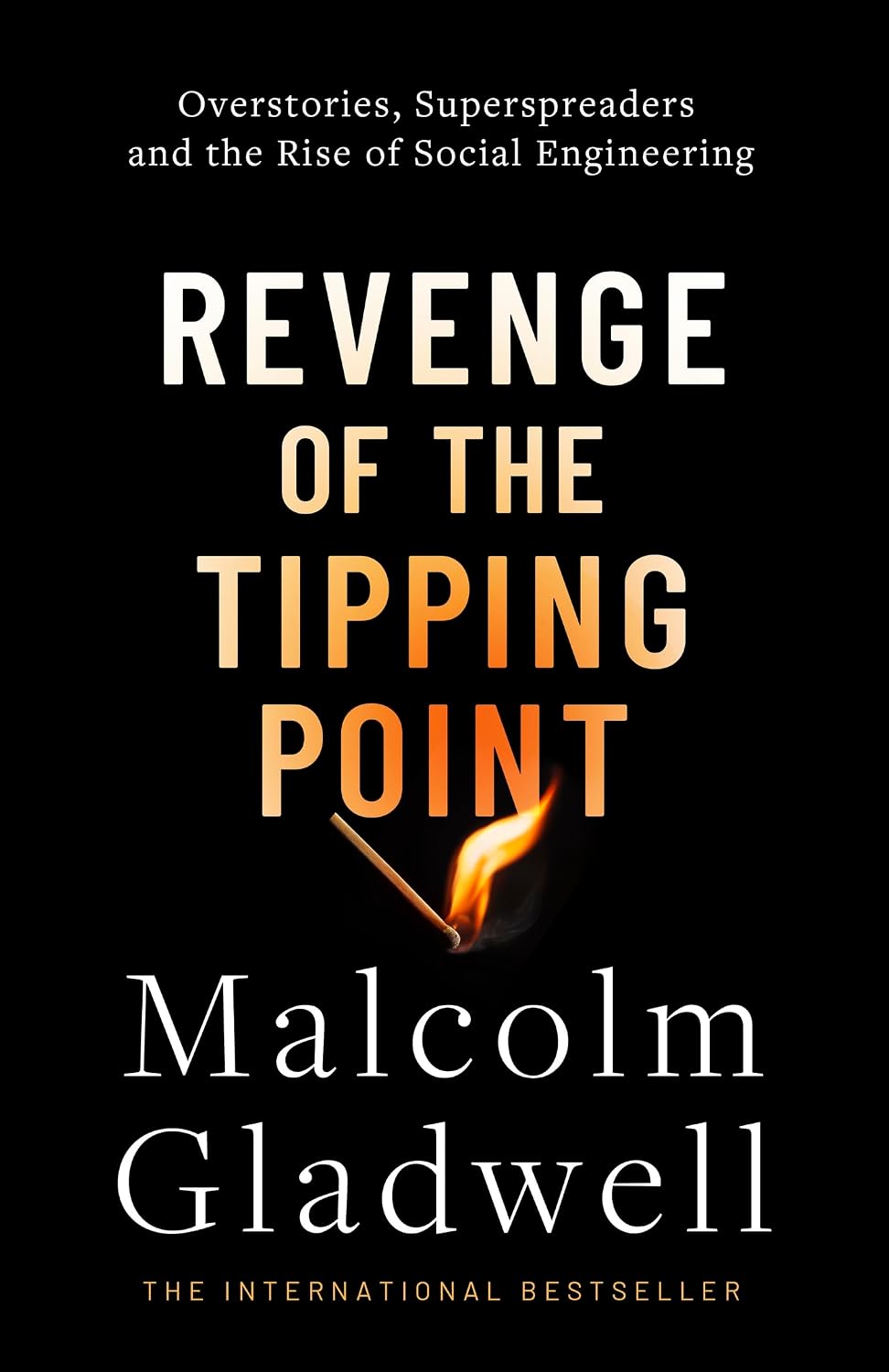
And so I’ve just finished reading Revenge of the Tipping Point (2024) and it has prompted some thinking about my main subject of interest, the climate and nature crises.
Revenge zooms in on apparent tipping points for social epidemics: bank robberies, Medicare fraud, an unnamed community’s sudden increase in school student suicides, ‘The Magic Threshold’ theory which relates to ratios of population cohorts within a wider population and its affects the wider population’s behaviour, Covid-19, marriage equality, and America’s opioid epidemic. I don’t have the expertise or time to explore any of these individual topics further, so I’ll take it on face value that Malcolm’s analyses and conclusions are at least broadly on track.
What I’m interested in is, How do we get communities behind ambitious action to mitigate and adapt to the climate crisis, and to stop and reverse the degradation of nature, in a way and to such an extent that genuine democracy overpowers the influence of extractive and polluting industries to drive public policy decisions?
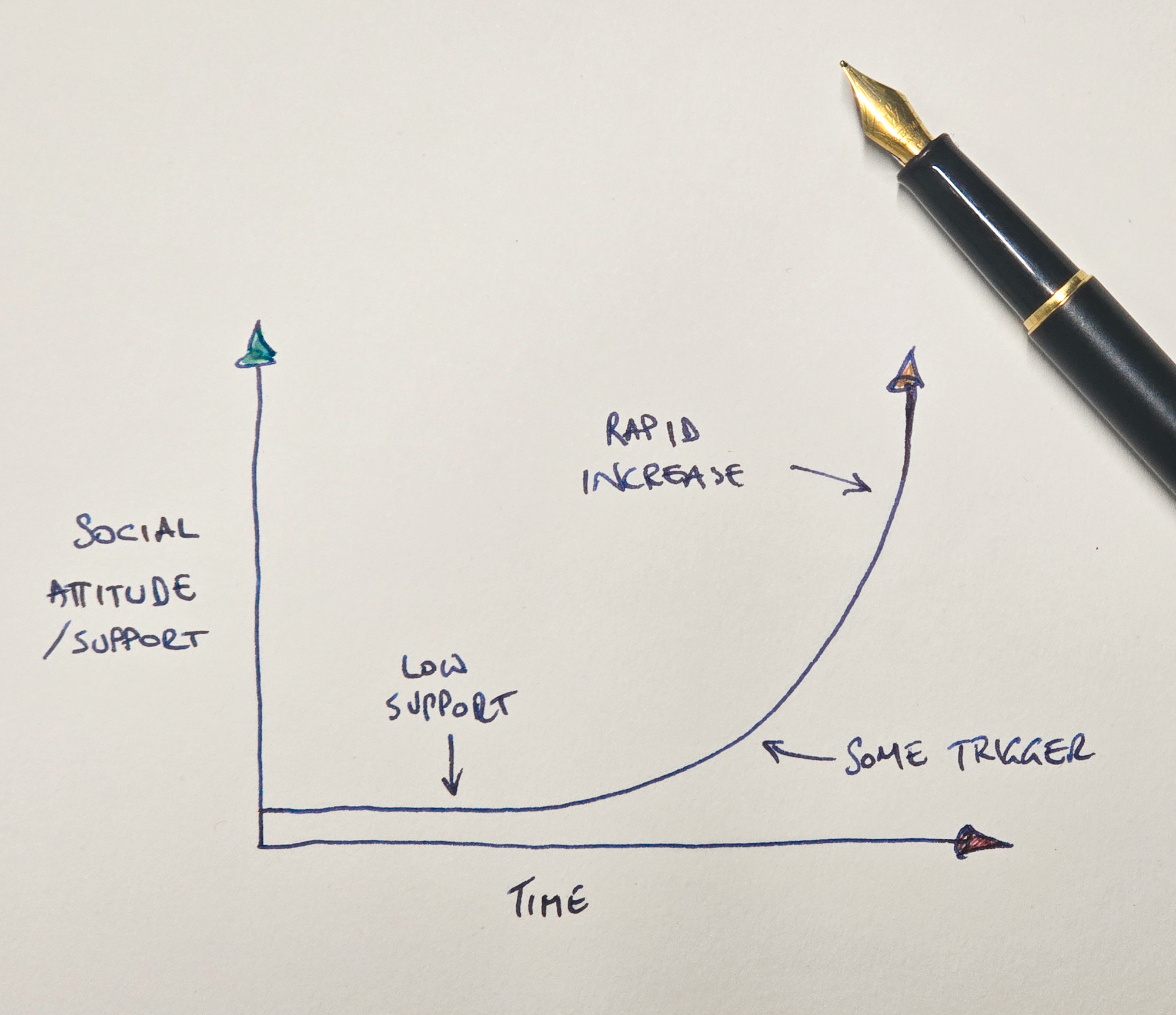
Exponential shifts in positive attitudes? (Graphic produced by hand, not AI.)
The social examples that Malcolm uses teach us very little about rallying public support for sustainability causes. His examples relate to far more immediate issues: the immediate or short-term well-being of students, minorities, Covid patients, and others, plus the finances of banks and governments that serve us all.
Any attempt to apply the tipping points he found to social responses to the climate and nature crises simply cannot work because:
The risks from the climate and nature crises seem, and often are, distant in time and/or geography, so the evolutionary psychology at play is entirely different.
Tipping points that do exist, like the acceleration of the EV market (which Gladwell cites in a podcast about tackling climate despondency) result from technological and market changes, rather than social, attitudinal or policy changes.
Tipping points, like the EV market, are very few, and they make barely a dent on the economy’s total greenhouse gas emissions and footprint of extracting nature.
We already know that a majority of people want more action to tackle the degradation of nature and the climate crisis, but the influence of extractive industries on major party and populist politics remains overwhelmingly toxic.
If you are looking at Malcolm’s work for ideas about how to engage the public on climate change and nature, then you have the right idea: We have to understand our underlying psychology, how it affects people’s attitudes towards these issues and, crucially, how it affects whether and how people act on these issues and what they expect from political and corporate decision-makers.
However, Malcolm’s work offers little more than a nice break from working on those heavy subjects. It’s interesting and fun and still worth reading, but it’s not helpful for tackling the political licence for ambitious action on the climate and nature crises.
Keynote address at Nature Positive Pathways Toward a Sustainable Future, Macquarie University, 15 August 2026
You can watch the address in the YouTube video above (from 35’30” to 55’30”) or read the transcript below.
Good morning Vice-Chancellor, everyone. And thanks to Macquarie University for inviting me to take on this issue of “Why We Should Care About Nature.” In doing so, I’m hoping you leave today with, not just a better understanding of why Nature matters, but also how profoundly problematic our harm to Nature is becoming, and what we need to do to turn the ship around. So, let’s get into it.
In 2010, King Charles published a book called, Harmony: A New Way of Looking at Our World, in which he lays out a wholistic understanding of Nature, and what it could look like in practice to live with, rather than against the cycles, rhythms and interconnections of all the systems that make up the world around us. The Australian Harmony Centre, here at Macquarie, is named in honour of His Majesty’s approach and life-long public service for environmental sustainability.
And in terms of why Nature matters to humanity, The King summarised it nicely in Harmony, saying,
“Whether we like it or not, this great living powerhouse is what sustains our well-being. … Nature is the source, not us.“
Indeed. And I would add that Nature provides 100% of the raw materials that make up 100% of our goods, whether it’s a scone or a skyscraper, because even synthetic materials, like steel, concrete and plastics, have natural materials and chemicals somewhere in their origin. Nothing is created from nothing.
It’s also important to recognise that humans are Nature too. We live as if we’re separate from Nature, but when it’s damaged and out of balance, someone, somewhere, at some point in time pays the price. If someone catches all the fish upstream, someone downstream goes without.
Highly relevant to the degradation and protection of Nature is climate change. Surveys show that Australians care deeply about Nature, but think of it mostly as being wildlife, the bush and beaches, while climate change seems to sit in its own category. But Nature and climate change are not things that can be understood separately. The degradation of Nature and climate change are two issues that are inextricably bound together. In fact, if we only focused on Nature, then climate change will undo all the work we do to protect and restore biodiversity and landscapes.
So, we need to bring these two issues together, for a more complete understanding of the natural world and our dependence on the health of all its various components.
Perhaps the best way to illustrate why we should care about nature is through examples of what’s happened when we haven’t quite cared enough, and when we haven’t seen Nature and the climate together.
Because of humanity’s burning of fossil fuels and clearing of forests, the average temperature of the world has gone up already by at least 1.44 degrees Celsius, and it’s forecast to go up by an additional 2 degrees or so over the next 75 years, so a total of between 3 and 4 degrees of warming by the end of the century.
The heat itself harmful, and so too is how that heat is disrupting the entire planet’s hydrological cycle.
As the world warms, there’s more evaporation and the atmosphere is holding more and more water vapour. Remember that a 1 degree rise in temperature means the atmosphere can hold up to 7% more humidity. So with global warming, the atmosphere now contains roughly 10% more water vapour than it did a century ago. And this is the seed for how climate change increasing the frequency, the scale and the intensity of weather-related disasters: droughts, bushfires, intense rainfall events, hailstorms, coastal storm surges, floods, landslips, and cyclones.
These disasters impact on Nature and, in turn, on the businesses and industries that rely on Nature. Some examples:
Spain, which produces roughly 40% of all the world’s olive oil, experienced its hottest ever year in 2022 coupled with one of its most extreme droughts. Its production of olive oil in that year dropped by 55%, from 1.5 million tonnes to 680,000 tonnes, and so olive oil prices jumped by 46%.
Another example: The hottest three years on record, in order, are 2024, 2023 and 2025, and the resulting heat stress on coffee plantations led to a decline in global production over that period. That in turn contributed to the commodity price of coffee jumping by 100% in those three years.
Another example: West Africa grows 70% of the world’s cacao. The region experienced an extreme drought and heatwave in 2024, which led to record low production levels, which in turn contributed significantly to a 400% increase in the commodity price of chocolate.
These examples might appear to relate only to climate change, but they demonstrate how climate change is disrupting ecosystem services for our food production systems; that is, Nature’s capacity to give essentials, like healthy soils and water in relatively predictable rhythms.
And I’ll share one more example, which ties into my earlier concern about addressing Nature but not climate change: Scientists have concluded that climate change made the Black Summer bushfires of 2019–2020 significantly more severe. Those fires killed an estimated 143 million native mammals, 180 million native birds, and 2½ billion native reptiles. Protecting Nature without addressing climate change can’t work. There’s an ecosystem in the ACT called “alpine bog and fen”, and conservationists have spent decades restoring and protecting this slow-growing, fragile habitat and its endangered species, and then 86% of it was burned in the Black Summer fires and scientists are not sure it will ever recover. We have to tackle climate change and Nature together.
This is just a tiny selection of examples. An international group of scientists prepare regular so-called “Planetary Health Check” reports, looking at various critical measures of Nature’s wellbeing. In their last report, which came out about a year ago, they found that the world has now breached 7 of 9 planetary boundaries – thresholds that keep life on Earth in a safe operating zone – biosphere integrity, climate change, ocean acidification, fresh water, introduction of synthetic chemicals and plastics, loss of forests. Breaching one of those should be cause for concern, and we’ve now breached 7 of 9.
We are also reaching so-called tipping points with climate change, at which problems start to run away on their own. For example, once we reach 2 degrees of global warming, virtually all the world’s coral reefs will perish, which is a catastrophe for all the sea life where coral reefs form a part of their food web.
Being so vastly out of harmony with Nature is clearly beginning to have enormous human consequences.
For several decades, people have been saying, “We need to save the environment for future generations”. Well, now we are that future generation. And since we’re only at the early stages of the climate and Nature crisis, we will see all these problems deepen and accelerate over the coming years.
Scientists have been issuing warnings about the dangers of degrading Nature and of climate change for many decades, so how has it gotten this bad? Human minds, as clever as they are, find it incredibly difficult to engage properly in issues understood to be distant in both time and geography.
But there’s another major reason. As a global community – not everybody, with Indigenous peoples being a clear exception – but as a global community, we’ve forgotten that we’re a part of Nature and we live as if we are disconnected from it. (In this case, I use the word “Nature” in the complete sense, including climate change.)
The clearest example of this disconnection from Nature is the model of our economy. In this model, Nature is a “free good” to extract and turn into “value” that goes into the marketplace for consumption by 8.3 billion people, without any serious thought of regenerating what was extracted.
To illustrate: Amazon sells more than 35 million items every day; items that were all made of materials extracted from Nature. In reward for mining Nature to this extent, Amazon is worth around 3 trillion US dollars. In contrast, the economy values the Amazon Rainforest at near zero dollars until it’s cut down for some “economic” purpose. There are many people and organisations working hard to put an economic value on Nature to try and get some balance into that structural problem, and that’s vital work and advances have been made, but it’s still a very long way from being anywhere near mainstreamed and able to compete or, preferably, outcompete the value of extraction.
I can’t overstate how profoundly our economy is disconnected from Nature. The Canadian conservationist, David Suzuki, said in a recent interview that, “We’ve made it so that it’s The Environment versus The Economy, and the game is fixed so that The Environment always loses.” Indeed. That’s how economics is theorised and taught, it’s how the economy is structured and locked into our legal system, and how it drives our political culture, including the policy advice that politicians get from both public and private sector analysts.
This is all clearly heavy stuff, but I don’t think it’s okay for anyone to talk about climate change and Nature, and say, “Everything is fine. We can carry on business-as-usual, except maybe some reusable shopping bags.”
For our safety, for our children’s safety, for our grandchildren’s safety, we absolutely must confront these facts head-on and ask, Can we turn things around?
The answer to that question is, “Yes and no.”
The bad news is that certain problems are now locked in no matter what we do. For example, even if we stopped all greenhouse gas emissions tomorrow, the sea-level will continue to rise, as will the number and scale of weather-related disasters.
But while it’s too late to prevent these disasters, and it’s not too late to stop these things from getting even worse.
To do that, we have five jobs:
First, we need to stop the things that are making the situation worse.
This is a huge job. The world currently spends around 312 billion dollars Australian each year on supporting Nature and climate solutions, but around 10.3 trillion dollars in damaging Nature and the climate every year.
We need to invert that ratio with massive-scale investments in renewable energy and other large-scale decarbonisation technologies and efforts.
In that same package, we also need to invest seriously in the people and communities whose situations rely on industries that need to be phased out, like fossil fuels. We can’t leave people behind. We have to lift people and the planet together, or there’ll be backlash and progress will continue to be stymied.
The second thing we need to do is to actively restore Nature.
This means investing at enormous scale in the repair and restoration of forests, wetlands, coral reefs and so on.
It also means investing in transforming our economy and businesses to be in harmony with Nature. A great example is regenerative agriculture, which is essentially the opposite of extractive agriculture, where the farming methods involve including Nature deliberately in the farm to improve soil, biodiversity, carbon sequestration, and the resilience of the farm to weather-related hazards, like droughts. But there are many examples.
Our third job is to get ready for the disasters that are coming now anyway, to keep everyone safe from fires, floods, sea-level rise, extreme heat, and so on.
Our fourth job is educating all Australians about these issues to try to calm the social consequences of the enormous policy and economic reforms that are needed to tackle this challenge.
Our fifth job is championing this scale and speed of action internationally, to encourage, incentivise and pressure other countries to lean into these challenges.
What I have just laid out is a monumental enterprise, but that’s what’s needed to avert catastrophe. But changing course is possible. Rather than be overwhelmed by that whole picture and freeze and do nothing, break it down into bite-size chunks and, piece by piece, we can all find ways to help make the future safer. Indeed, what you don’t see in the news is that positive change is already happening at a big scale, albeit not yet at the scale truly needed.
But let’s get into some good examples.
Starting with, what has been described as “the United Nations for the private sector”: In 2020, King Charles founded the Sustainable Markets Initiative, or SMI, which is where I work now. The SMI works with large‑scale, global corporations to rally big investments in climate and Nature solutions. In its first five years, the SMI’s members invested and ring‑fenced $2 trillion for such projects; a scale that reflects The King’s ambition and impact, but also the existence now of effective large-scale solutions.
Another good example: In the year 2000, Australia’s electricity system was just 10% renewables; 90% coal and gas. But in the 6 months from October to March just gone, over 50% of Australia’s electricity came from renewable sources, and crucially, the use of coal and gas is going down year after year. Australia once had the worst greenhouse gas emissions per person of any country in the world, but that’s halved over the last 20 years.
Improvements to electricity supply is an example of what I call a system‑level change. On our own, we can’t change a whole system like the electricity network. But we can tell the people who influence those systems that we want improvements. Tell the politicians you support – for whatever reasons (I’m not telling you who to vote for) – that you want them to care about our safety and about the changes needed to ensure that. Tell the companies whose products you like that you want them to be more environmentally-friendly – made with renewable energy, with sustainably-sourced raw materials, and with alternatives to plastics. When more of us tell decision-makers in these systems that we want things to improve, they respond, even if it takes a wee while and even it’s hard for us to see from where we sit.
For me, these conversations with decision-makers sit at the heart of why we haven’t seen enough positive change: There simply hasn’t been enough demand from the public for changing these big systems. Surveys continually find that most Australians agree that climate change is happening and that they want more action. But there’s a phenomenon in human psychology in which many people privately care about something, but they believe—mistakenly—that most other people don’t, so they don’t speak up or act; they’re subconsciously going along with what they think is normal, not ruffling any feathers. Well, since surveys show most Australians care about Nature and the climate, you can safely have conversations about these topics with most people in your lives. Ask them what worries them about climate change and the degradation of Nature. Tell them what worries you. Share ideas on what you can do about it all. These conversations are critical for creating public momentum to demand more action and also to create the permission space for politicians to implement big reforms at that systems level.
On top of that, there are loads of meaningful things you and I can do day-to-day. I’m not going to give you a shopping list of options for how to live with a smaller Nature and carbon footprint, but Google it and you’ll find loads of great ideas – but remember:
That everything we buy comes from Nature, almost certainly from an extractive, unsustainable process; and
That fossil fuels were burned to make that stuff and transport it from place to place until it gets to our homes; and
That much of it will end up in landfill, not recycled.
With these things in mind, you will start to see what options have big and small environmental footprints.
As you do it, don’t try to do everything you think of, because that can be overwhelming. I’d recommend you start with a few things, and build up changes over time so it’s easier to adjust. And keep sharing ideas with family and friends.
Well, hopefully I’ve achieved my goal today of helping improve the understanding of why Nature matters, of how profoundly problematic our harm to Nature is becoming, especially when we think of Nature and climate together, and of what we need to do to change direction.
Climate change and sustainability professionals like myself know all too well that it can seem overwhelming. But we also know that it’s less overwhelming when we’re acting, and each and every one of us can assert some positive influence to help our society and economy make more progress like we’ve seen with Australia’s renewable electricity story and, ultimately, to help make the future safer.