When people learn that my career is about tackling climate change and advancing ecological sustainability, I am sometimes asked, with an agonising, sheepish look, “But there is hope, right?”
(Continues below the photo)
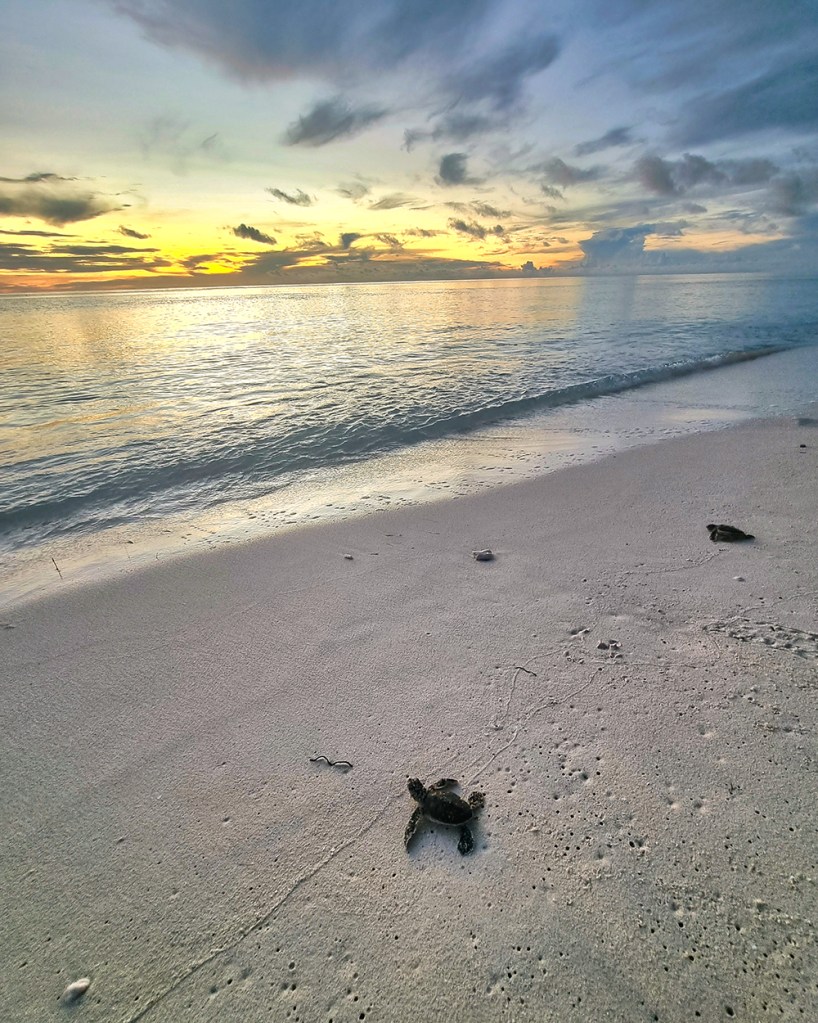
The Conflict Islands comprise a privately-owned marine conservation park, managed by marine biologists and rangers who have increased the survival rate of hatchlings from roughly 5% to roughly 95% by looking after the nests and releasing the hatchlings to the sea when predators aren’t around.
The question of hope is asked as if, were I to say “No,” then I would be failing in some moral way; not someone else. The question feels loaded, as if I am responsible for their sense of hope, and if I don’t give it to them, then I am being heartless.
Whether we succeed or not in preventing the climate and nature crisis from deepening and causing even greater catastrophes, is that my personal moral failure? Reasonable people could differ on whether I’ve led a moral life, but I think I do okay in that respect.
By contrast, I agree that the deepening crisis is symbolic of my profession’s failure.
To-date, everyone who works on sustainability has, to put it bluntly, failed, since the climate and nature crisis has worsened. Brilliant people have helped make important gains, they’ve designed and delivered great projects, and they continue to do so, and all of that has definitely slowed the deteriorating situation. Nevertheless, the combined impact of all this great work has not been anywhere near enough to prevent the disasters that are now unfolding.
In our defence, sustainability professionals bare only the tiniest responsibility.
Our main failure has been that we did not develop and—crucially—socialise a series of pragmatic policy proposals to tackle the root cause of non-sustainability: the rapacious, extractive economic system that is embedded completely into our collective psychology and political cultures, and which makes it virtually impossible to live sustainably.
Doughnut Economics is a brilliant attempt at a practical policy tool, but despite its brilliance, its adoption has been unfortunately limited. All power to the Doughnut Economics Action Lab in growing their influence and impact.
Since that rapacious extractive economic system still flourishes, that brings me back to the question, Is there hope?
Even without the moral overtones, the question of hope is complicated. It’s presented as a yes or no question, but the climate and nature crisis is nowhere near that simple.
There are reasons for profound anxiety. Many of the best sustainability professionals I know lose sleep, literally, because of the stress caused by having intimate knowledge of all the problems and, therefore, being a voyeur on the end of the world as we know it. Terrible things are now locked in and unpreventable.
An important part of why this is so stressful is that, as well as understanding the problems, sustainability professionals also know that the climate and nature crisis was entirely preventable; that we could stop the harmful things humanity is doing; that we could turn the ship around; but also that the extractive economic system is too big and too powerful, and it is bolstered by people, values and cultures that do not understand, or refuse to understand, or don’t care about the calamities being created by the system they support.
The public is increasingly aware that the economic system is failing them, but more and more are going down the rabbit hole presented by populists, instead of looking for genuinely effective solutions. The populists are a useful vent for anger—and people should be angry with the cheerleaders for flailing and destructive economics—but nothing else. Certainly, when it comes to scientific literacy, populists are, at best, ignorant and, at worst, environmental despots, making our futures less safe and less prosperous. Populists have no answers for the climate and nature crisis that aren’t moronic.
And so, with growing support for populists who want to dump the Paris Agreement and Net Zero goals (which are, in any case, only a piss-weak target; far short of what’s needed for public safety), we sustainability professionals see our communities sliding further away from solving the climate and nature crisis.
The frustration is that the economic, technological, policy and behavioural solutions already exist.
Read that again.
The economic, technological, policy and behavioural solutions already exist.
So, what are we waiting for? Why aren’t they being rolled-out and the necessary speed and scale to stop and reverse the crisis?
The Social Licence Crisis
The fundamental problem is that there is still—a staggering 130 years after the first peer-reviewed scientific paper on anthropogenic global warming—the social licence crisis.
The social licence crisis is this situation now, where we have a continuing and generous social licence for environmental bads, like fossil fuels, and insufficient social licence and, indeed, demand for truly ambitious and effective environmental and economic reforms.
Hope will only exist if we are tackling the social licence crisis; if we can invert that ratio; if we can deprive environmental bads of public acceptance, and if we can create a public insistence for ambitious, rapid environmental and economic reforms.
If someone’s approach to sustainability is just ‘hope’ and leaving it to others, then that someone is accepting (perhaps unknowingly) that there just isn’t enough of us to create the necessary momentum for reform.
If, on the other hand, you’re prepared to act, if you are part of inverting the social licence ratio and helping build massive public pressure for reform, then there is hope that things will be less bad. But you have to decide to take action, at home, at work, and in your community. And it has to be one of, if not the highest priority with your local member(s) of parliament, and when you’re in the ballot box, since it’s the politicians who create the laws that make the future or not.

